A new study published by the European Space Agency (ESA) has revealed groundbreaking findings about the fiery demise of the Aeolus satellite. The satellite, launched in 2018, was designed to measure global wind patterns from space, but its mission was tragically cut short when it plunged back to Earth in April 2023.
The ESA study revealed that, rather than breaking up in the atmosphere, Aeolus experienced what is known as a “re-entry flash.
If you’re an astronomy enthusiast, you won’t want to miss the latest Hubble image of the Jellyfish Galaxy, also known as JO175. This gorgeous spiral galaxy is found in the constellation of Lynx and is estimated to be about 200 million light-years away from Earth. The intricate details of this galaxy can be seen in the image, from the bright core of the galaxy to the star-forming regions that fan out like a jellyfish’s tentacles.
A new machine-learning method has been developed to help scientists better understand fundamental aspects of complex systems. Published in Nature Communications, the new technique combines ideas from both machine learning and statistical physics, allowing for the analysis of large datasets that reveal the underlying structure of a system. This method can be used to study the behavior of phenomena ranging from chemical reactions to the spread of infectious diseases. By illuminating the fundamental aspects of complex systems, this research can provide insights into a wide-range of situations, helping scientists make better decisions and create better policies.
Today, scientists have developed a revolutionary new tool that promises to revolutionize our understanding of how cells work. The new probe, developed by a team of researchers at the Institute of Molecular Biology and Genetics, is designed to help researchers better understand how cells function and how they interact with the environment. The probe is able to detect and measure changes in a cell’s physiology, metabolism and even gene expression. This will allow researchers to better understand how cells respond to different environmental conditions, and how they interact with other cells and the environment.
In a groundbreaking discovery, the James Webb Space Telescope has discovered a previously unknown asteroid belt surrounding the star Fomalhaut. This discovery marks the first time that an asteroid belt has been found outside of our own Solar System. Scientists believe that this new belt could provide important insights into the formation and evolution of planetary systems around other stars. The discovery also confirms the existence of a mysterious dust cloud that had been observed near Fomalhaut for decades.
A recent study conducted by astronomers at the University of Arizona has found unusual “tidal tails” in the galaxy pair Arp 147. Tidal tails are long structures composed of gas and dust that are formed when two galaxies interact with each other either through a collision or gravitational pull. The astronomers used the Large Binocular Telescope in Arizona to observe the two galaxies and were able to detect the tidal tails in the form of two long arcs of gas and dust extending from the two galaxies.
In a groundbreaking discovery, scientists have uncovered a galactic complex far outside of our own Milky Way. This complex, which consists of three spiral galaxies, is thought to be the largest structure ever observed in the universe. Researchers believe that the complex is around 300 million light-years in diameter, which is nearly six times larger than the size of our own galaxy. The discovery of this structure is providing us with new insights into the formation and evolution of galaxies in the early universe.
We live in an ever-evolving world where technology is advancing faster than ever. In the past, we have gained a better understanding of the universe due to the development of new tools and methods, but now scientists are looking to gain a deeper understanding of space through the use of AI. With the help of AI, scientists are now able to more accurately identify, predict, and observe the behavior of objects in the universe.
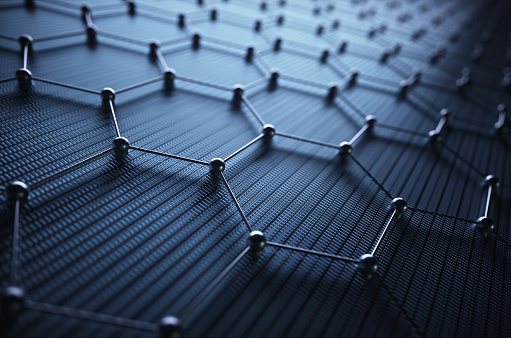
Graphene quantum dots (GQDs) have recently been gaining attention as a promising material for a variety of applications. GQDs are tiny flakes of graphene with a size of about 5-10 nanometers, and their unique electronic and optical properties make them a promising material for the future of quantum computing and energy storage. In a recent study, researchers from the Institute of Physics, Chinese Academy of Sciences have demonstrated a new way of producing GQDs with a symmetric structure, which could bring us one step closer to realizing the potential of these tiny flakes.
The future of imaging technology is here! Scientists have discovered a new type of material, called scintillators, that can detect even the most subtle changes in light. This breakthrough technology has the potential to revolutionize the way we view and understand the world around us. Scintillators are made up of tiny crystals that can detect even the smallest changes in light intensity and wavelength, making them ideal for use in medical imaging, security systems, and other applications.
In a world where television is dominated by fast-paced, action-packed shows, a new type of show is captivating viewers in Sweden—slow-paced nature TV. This genre of programming is designed to give viewers an intimate, up-close look at the natural beauty of the Swedish landscape, with episodes focusing on single species, or on a single location. In a recent survey, viewers reported feeling more connected to nature and more relaxed after watching the show, with many saying it provided a sense of calm and peace.
In recent years, we have seen the rise of a new form of psychology known as mathematical-based psychology. This type of psychology is based on the use of mathematical models and data-driven insights to better understand how people think and behave. In this article, we explore how these mathematical models can be used to help people make better decisions about what to buy and how to stay trendy.
Mathematical-based psychology can be used to provide insights into consumer behavior and trends.
Recent advances in biotechnology have made it possible to isolate and analyze extracellular vesicles (EVs), which are small membrane-bound particles released by cells. These EVs can be used for a variety of applications, such as diagnostics, drug delivery, and tissue engineering, and are an important tool for understanding cell communication and disease. However, isolating EVs can be challenging, since they are so small and often found in complex mixtures. To address this challenge, researchers have developed a protocol for maximizing EV isolation.
Migrating birds have become a common sight in the skies of Chicago, as they fly through the city to their summer nesting grounds. But what many people don’t realize is that this journey is a dangerous one. Researchers at the University of Chicago have found that the birds are being increasingly threatened by the city’s skyscrapers, which can cause fatal collisions. The researchers have identified certain areas of the city, such as the Loop and Navy Pier, as particularly hazardous for the birds.
NASA is taking hurricane monitoring to a whole new level with their new small satellite program. The program will utilize small satellites to track and monitor hurricanes from space, providing enhanced data and more accurate forecasting of the storms. The small satellites will be able to provide detailed information about the hurricane’s size and intensity, as well as the direction and speed of the storm. This data will be invaluable for coastal communities in preparing for and responding to hurricanes.
In recent years, medical science has seen a revolution in the way embryos are monitored and tracked during their development. Now, researchers from the University of California, San Diego (UCSD) have taken this technology one step further, developing a new automated system that can detect and diagnose developmental defects in embryos. The system, which uses a combination of advanced imaging techniques and machine learning algorithms, is the first of its kind to accurately detect and diagnose defects in embryos.
It’s been a long-standing mystery as to how the Moon stays hydrated, with its dry, dusty surface. But now, a group of researchers have an answer - microwaves. By heating up the lunar regolith - the loose material covering the Moon’s surface - the researchers have discovered that it releases water. This opens up the possibility for humans to one day mine the Moon for its water and use it for drinking, manufacturing water or even fueling rockets.
A new technique to rapidly diagnose neurodegenerative diseases such as Parkinson’s disease has been developed by researchers at the University of Tokyo. The technique, which uses advanced imaging technology to detect changes in the brain, has been shown to correctly identify the disease in patients in just a few hours. This could revolutionize the way neurodegenerative diseases are diagnosed, as it is currently a slow and arduous process. The findings of the new study are a major step forward in the diagnosis of neurodegenerative diseases, and could lead to earlier diagnosis and more effective treatments.
Revolutionizing Spectrometry: Introducing the Compact, High-Resolution Spectrometer with Flat Optics
Scientists have unveiled a new compact, high-resolution spectrometer that uses flat optics technology to measure light from the environment. This groundbreaking instrument is the first to use flat optics, a technique that projects light onto a two-dimensional plane, as opposed to the traditional three-dimensional curved optics. The new spectrometer is designed to be used in a wide range of applications, from environmental monitoring and medical diagnosis to industrial process control. It promises to be a powerful tool that can capture and analyze light with unprecedented accuracy.
In recent years, scientists have been researching ways to reduce the amount of antibiotics that are entering our water systems. Now, researchers at the Technical University of Munich (TUM) are developing a new low-temperature plasma technology that can help to remove antibiotics from wastewater.
This new technology is based on a process called plasma oxidation, which uses plasma to break down organic compounds. The process works by creating an electric field, which produces ions and electrons to break down the organic compounds.
The Relativistic Heavy Ion Collider (RHIC) at Brookhaven National Laboratory is ready to launch its first series of high-energy gold ion collisions. This is a major milestone for the facility, as it marks the first time it has used gold ions in its experiments. The gold ions will be accelerated to nearly the speed of light and then collided with other particles, allowing scientists to study the conditions of the early universe.
Today, scientists have uncovered the protein responsible for the long-sought after ‘sayonara gene’. This revolutionary discovery could have massive implications for many different fields of science, ranging from genetics to biotechnology. It is believed that this protein could be used to manipulate genes, allowing for the creation of more sophisticated medicines and treatments. It could also be used to help improve crop yields and agricultural production. This discovery could have far-reaching implications, and will no doubt change the way we think about genetics and biotechnology.
Scientists have recently discovered a new enzyme that can silence specific genes in DNA. This groundbreaking discovery could lead to a revolution in gene therapy and potentially revolutionize the way we treat diseases. The enzyme, called DNA methyltransferase 3a (DNMT3a), is able to recognize and modify certain genes without affecting the rest of the DNA. This could allow scientists to target and disable only the genes responsible for a particular disease, while leaving healthy genes untouched.
We’re in the future now! Scientists have just developed a revolutionary way for us to take our lab experiments with us on the go. It’s called the iPod Portable Droplet Microfluidic, and it’s a tiny device that fits in the palm of your hand. It’s packed with the same technology used in advanced lab experiments, and it’s designed to be used in almost any environment. Not only can it analyze small samples of liquid, but it can also detect bacteria, viruses, and other pathogens.
In an amazing breakthrough in quantum science, scientists have recently tracked electron re-collisions in real-time for the first time ever. This means that, for the first time, scientists can observe how electrons interact with each other during a collision. This is a huge development in quantum physics, as it will help us to better understand how matter behaves on the nanoscale. By understanding electron re-collisions, scientists can look at how matter is affected by different environmental factors, such as temperature and pressure, and create more efficient and powerful materials.